
What is alopecia areata?
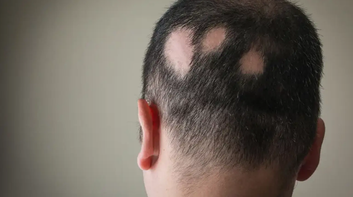
Alopecia areata is an autoimmune condition in which the immune system mistakenly attacks hair follicles, causing hair to fall out. It most commonly produces one or more smooth, round or oval patches of hair loss on the scalp, but it can also affect the beard, eyebrows, eyelashes and other body hair.
Unlike pattern hair loss, alopecia areata does not primarily result from gradual follicle miniaturisation. The follicles generally remain present, which is why hair can potentially regrow when the immune activity settles.
Can hair grow back on its own after alopecia areata?
Yes. Spontaneous regrowth is possible, particularly when alopecia areata is limited to a small number of patches and has been present for less than a year. Some people may see hair begin to return without treatment.
However, spontaneous regrowth does not mean that alopecia areata has permanently gone away. The condition can come and go, and new patches can develop even after previous areas have recovered.
This is why it is difficult to predict exactly when hair will return or whether further episodes will occur.
How long does it take for hair to grow back?
There is no fixed timeline.
Some people begin to see early regrowth within a few months, while others take considerably longer. The timeline depends on factors such as the extent of hair loss, how long the patches have been present and whether the disease is still active.
When treatment is effective, regrowth can also take time. For example, people receiving corticosteroid injections for limited patchy alopecia areata may begin to see regrowth within around three months.
New hair may initially appear fine or lighter in colour before gradually becoming more like the surrounding hair.
Does alopecia areata always grow back?
No. Some people experience complete regrowth, while others have persistent or recurrent hair loss.
The outlook tends to be less predictable when alopecia areata is extensive, has been present for a long time or involves the entire scalp or body. Alopecia totalis refers to complete scalp hair loss, while alopecia universalis involves loss of hair across the scalp and body.
The disease can also fluctuate, with periods of regrowth followed by new episodes of hair loss.
What treatments can help hair grow back after alopecia areata?
Treatment depends on the extent and pattern of hair loss, how long the condition has been present and whether it is continuing to progress.
For a few limited patches, corticosteroid injections are an established treatment. The medication is injected directly into the affected areas, usually at intervals determined by the dermatologist. Topical corticosteroids may also be used in appropriate patients.
For more extensive alopecia areata, treatment may involve medications that act on the immune pathways involved in the condition.
What are JAK inhibitors for alopecia areata?
JAK inhibitors are a newer class of medicines that have changed the treatment of moderate-to-severe alopecia areata.
They work by blocking specific signalling pathways involved in the abnormal immune response affecting hair follicles. Depending on the country and regulatory approvals, medicines including baricitinib, ritlecitinib and deuruxolitinib are now available for certain patients with extensive or severe alopecia areata.
Recent clinical evidence continues to show that oral JAK inhibitors can produce meaningful scalp, eyebrow and eyelash regrowth in people with moderate-to-severe disease. They are prescription medicines and require appropriate patient selection and monitoring because they can have significant side effects.
They are therefore not a treatment that should be started simply because someone has a small bald patch.
Can alopecia areata affect eyebrows, eyelashes or beard hair?
Yes. Alopecia areata can affect hair anywhere on the body, including the beard, eyebrows and eyelashes.
Treatment depends on the area involved and the extent of hair loss. In some cases, corticosteroid injections or other treatments may be considered. JAK inhibitors may also produce regrowth in the eyebrows and eyelashes of some patients with more extensive disease.
Loss of eyelashes deserves particular attention because eyelashes provide some protection for the eyes.
Is alopecia areata the same as normal hair loss?
No. This distinction is important because the treatment depends on the cause of hair loss.
Alopecia areata is an autoimmune condition and typically produces distinct patches of hair loss. Pattern hair loss, on the other hand, causes progressive miniaturisation and thinning in characteristic areas of the scalp.
Other conditions, including telogen effluvium, scalp infections, inflammatory scalp diseases and nutritional or medical problems, can also cause hair loss.
A dermatologist may examine the scalp and hair closely, use trichoscopy, and order blood tests or occasionally a scalp biopsy when the diagnosis is uncertain.
Can stress cause alopecia areata?
Stress is often discussed in relation to alopecia areata, but it is too simplistic to say that stress directly causes the condition.
Alopecia areata is an autoimmune disease involving the hair follicle. Some people report that their hair loss began or worsened around a period of significant physical or emotional stress, but the relationship is complex.
It is therefore important not to blame yourself for developing alopecia areata or assume that reducing stress alone will make the hair grow back.
When should you see a dermatologist for alopecia areata?
It is worth getting a diagnosis if you notice a sudden, clearly defined patch of hair loss, particularly if the patch is smooth and has appeared relatively quickly.
Early assessment can establish whether the problem is actually alopecia areata and determine how extensive or active it is. This is particularly important if new patches are appearing, hair loss is spreading, or the eyebrows, eyelashes or beard are involved.
Treatment may not be necessary for every small patch, but knowing what you are dealing with allows you to make an informed decision about observation versus treatment.
How does Dr. Sanchit Talwar treat alopecia areata?
Alopecia areata needs to be approached differently from common forms of hair thinning.
Dr. Sanchit Talwar begins by assessing the pattern and extent of hair loss and confirming the diagnosis. The examination may include trichoscopy and, where appropriate, investigations to rule out other causes of hair loss.
Treatment is then selected according to the severity and pattern of alopecia areata. For limited patchy disease, this may involve local treatments such as corticosteroid injections. More extensive or persistent disease may require consideration of systemic treatments, including newer targeted therapies such as JAK inhibitors where appropriate.
The aim is not simply to stimulate hair growth, but to control the underlying autoimmune activity responsible for the hair loss and choose treatment according to the individual patient’s disease.
The bottom line
Yes, hair can grow back after alopecia areata. Some people experience spontaneous regrowth, particularly when the condition is limited to a few patches. Others need treatment, especially when hair loss is extensive, persistent or continuing to progress.
Because alopecia areata can behave unpredictably, a dermatologist can help determine the diagnosis, assess the extent of hair loss and decide whether observation or active treatment is appropriate.
If you have developed sudden or patchy hair loss, Dr. Sanchit Talwar can assess the cause and discuss the treatment options appropriate for your pattern of alopecia areata.